What the wavelength actually does
Every hair-removal device works on the same principle: light of a chosen wavelength is absorbed by melanin, converted to heat, and that heat damages the follicle's ability to regrow hair. The difficulty on Indian skin is that melanin is not only in the hair. It is in the skin around it too.
Shorter wavelengths are absorbed strongly by melanin, which makes them efficient on dark hair under pale skin and risky on Fitzpatrick IV and V, where the surrounding skin competes for the same energy. Longer wavelengths are absorbed less strongly overall but penetrate deeper and interact less with surface pigment — which is exactly the trade-off you want on deeper skin.
That single fact is the reason a device that is entirely appropriate in one country can be the wrong choice here.
Diode at around 810nm
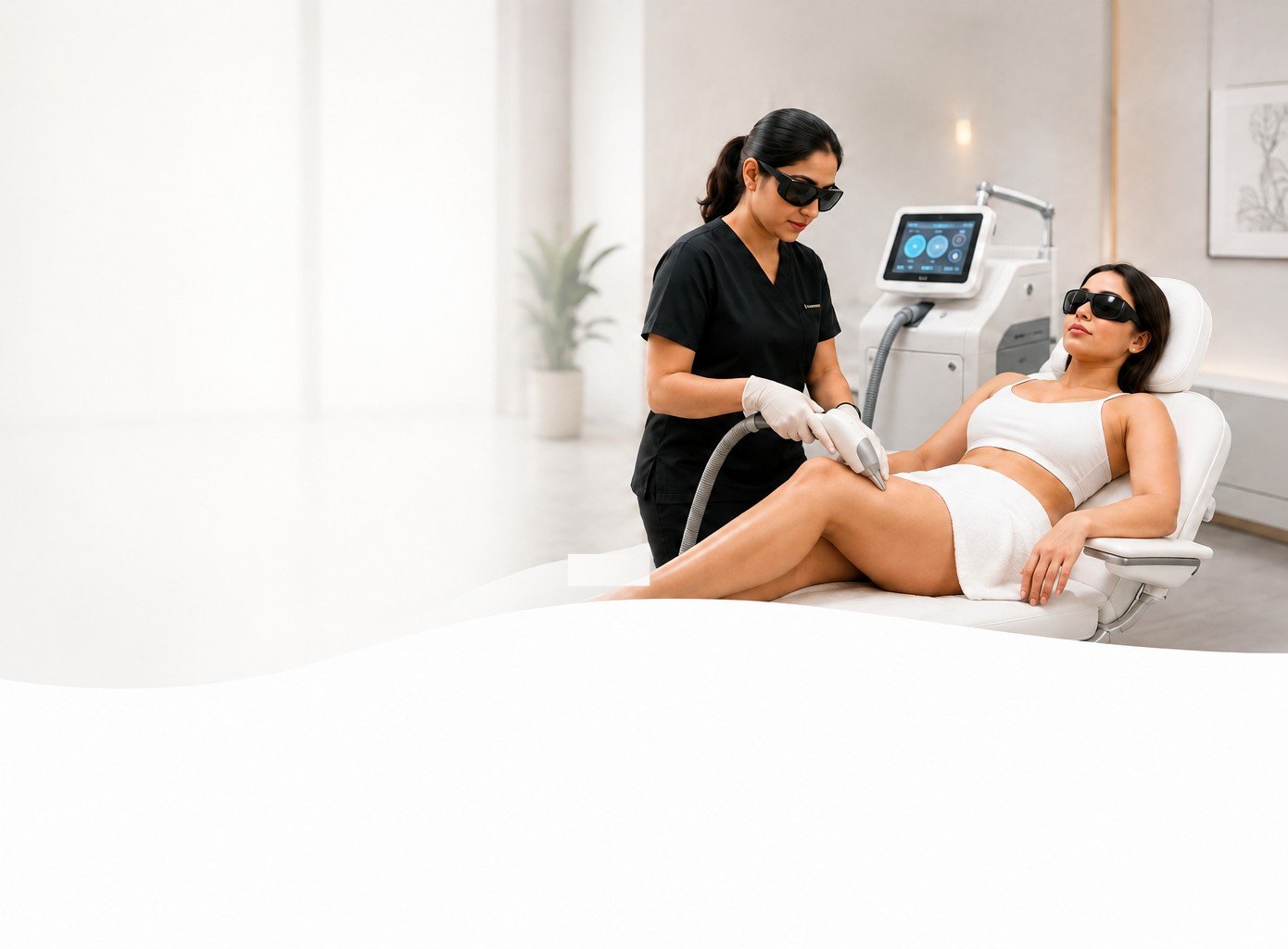
The workhorse for most body hair removal. It sits in a useful middle: long enough to be reasonably safe on deeper skin, short enough to be efficiently absorbed by the hair, and it covers ground quickly, which matters on legs and backs.
Modern diode systems use contact cooling — the handpiece chills the skin surface as it fires — which both protects the epidermis and makes the treatment considerably more comfortable than the reputation laser carries.
Diode is less forgiving as skin gets darker. On Fitzpatrick V and VI it demands a more careful hand and more conservative settings, and it is not automatically the right answer.
Nd:YAG at 1064nm
The longest of the wavelengths in common use, and the safest choice for the deepest skin tones. At 1064nm the light passes through the pigmented upper layers with much less absorption and releases its energy deeper down, at the follicle rather than at the surface.
The trade-off is that melanin absorbs it less strongly overall, so it needs more energy to achieve the same follicular damage — which is felt more. It is the device of choice where safety on deep skin matters more than comfort, and where diode would be pushing its luck.
It is also more tolerant of a fresh tan than diode, though a tan still means deferring rather than proceeding.
IPL is not a laser
This is the single most useful thing to know before comparing prices anywhere in Chennai, because a great deal of what is advertised as laser hair removal at low prices is intense pulsed light.
A laser emits one wavelength, coherent and focused. IPL emits a broad band of wavelengths from a flashlamp, scattered across a range. It can reduce hair, but it is far less precise about what it heats, and on deeper skin tones it is the least predictable of the options — because a broad band inevitably includes wavelengths that surface melanin absorbs strongly.
It is also the technology in most home devices. If a price looks dramatically lower than everywhere else, ask which device and which wavelength, and expect a straight answer.
What actually determines your result
The device matters less than most marketing suggests, and less than three other things.
First, whether anyone assessed your skin type and hair type before choosing settings. Second, whether a patch test was done and reviewed before a full session. Third, whether settings are started conservatively and built up across the course rather than set at a number that worked for the last patient.
A well-run course on a mid-range diode beats a badly-run one on the most expensive platform in the city, every time. When you ask a clinic which machine they use, listen less to the name and more to whether they can explain why that wavelength suits your skin.
Frequently asked
Which laser is best for Indian skin?
Longer wavelengths. Nd:YAG at 1064nm is the safest for the deepest tones because it passes through pigmented surface layers and releases energy at the follicle. Diode at around 810nm is the common workhorse and is appropriate for most Fitzpatrick IV skin with conservative settings. Shorter wavelengths are the ones to be cautious about.
What is the difference between diode and Nd:YAG?
Wavelength, and what that trades off. Diode at ~810nm is absorbed more strongly by hair and covers ground quickly, but is less forgiving as skin gets darker. Nd:YAG at 1064nm penetrates deeper and interacts less with surface pigment, making it safer on deep skin — at the cost of needing more energy, which is felt more.
Is IPL the same as laser hair removal?
No. A laser emits a single focused wavelength; IPL emits a broad band from a flashlamp. IPL can reduce hair but is far less precise about what it heats, and on deeper skin tones it is the least predictable option. Much of the cheapest advertised "laser" is IPL, so ask which device is being used.
Does the machine matter more than the operator?
No, and it is not close. Whether your skin and hair type were assessed, whether a patch test was done and reviewed, and whether settings were started conservatively and built up matter more than the brand on the machine. A well-run course on a mid-range diode beats a badly-run one on an expensive platform.
What wavelength do you use?
Diode and Nd:YAG platforms, chosen per patient rather than per clinic policy — which one you are treated with depends on your Fitzpatrick type, your hair, and how the patch test reads.
Laser gives long-term hair reduction, not permanent removal. This page is educational and does not replace an in-person consultation. Reviewed by our clinical team, last updated 21 August 2026. Medical disclaimer